
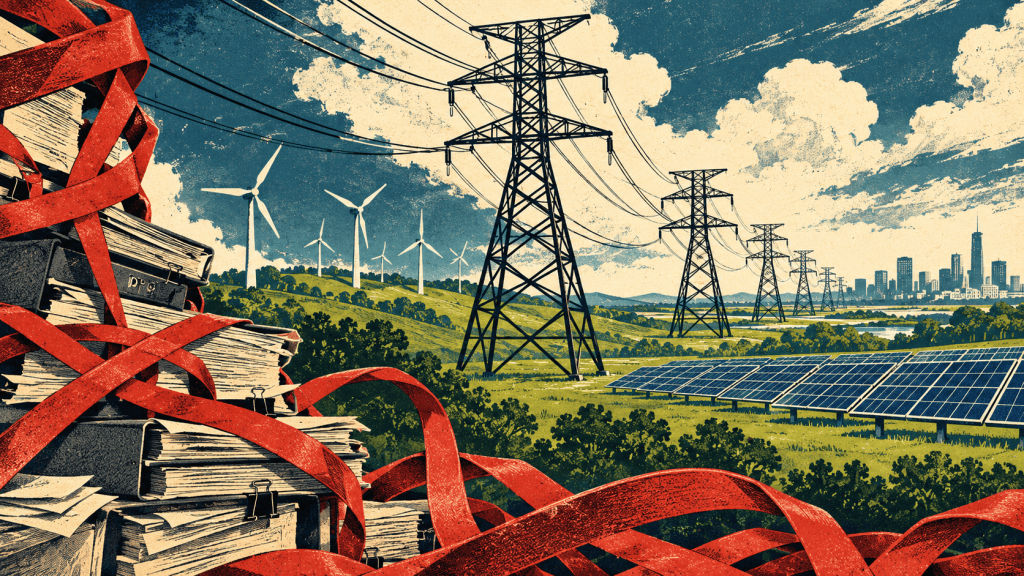
There is a contradiction at the heart of the American environmental movement that we can no longer afford to ignore. We want to transition away from fossil fuels, electrify our economy, and build an energy system capable of supporting the industries of the future. Yet we have created a system in which building the infrastructure necessary to accomplish those goals can take decades.
Now Congress has an opportunity to change that. And I worry that parts of the political left are preparing to let it slip away.
The Bipartisan American Affordability and Jobs Act (BAAJA), S. 5653, represents a rare attempt to address structural barriers to building energy infrastructure. The legislation is far from perfect. It would change important environmental-review and litigation procedures, potentially constrain opportunities for judicial remedies, and make it easier to develop fossil-fuel infrastructure alongside clean-energy projects. These concerns deserve serious consideration.
But reducing the debate to a choice between environmental protection and corporate deregulation misses something fundamental: the inability to build is itself an environmental, economic, and political problem.
The Environmental Cost of Not Building
Consider the SunZia transmission project, designed to carry renewable electricity from New Mexico toward Arizona and markets in the Southwest. Its long development history, spanning roughly 17 years from early planning through major construction milestones, reflects permitting, land-use, financing, and community-negotiation challenges—not just one environmental law.
Wind and solar resources are not distributed evenly across the country. Some of the best wind resources are far from the cities and industries that need electricity. Without transmission, we cannot fully capitalize on them.
We can build all the wind turbines and solar panels we want, but if we cannot move their electricity to consumers, their value is constrained. Transmission is one of the foundations of a cleaner electricity system.
The environmental consequences of building a project deserve scrutiny. But so do the consequences of delaying or preventing infrastructure that could displace fossil-fuel generation, improve reliability, and reduce the cost of electricity. A serious environmental policy must account for both.
When Environmental Protection Becomes an Instrument of Obstruction
The National Environmental Policy Act (NEPA), National Historic Preservation Act (NHPA), and Endangered Species Act (ESA) serve important purposes. They require federal agencies to consider environmental consequences, protect historic and cultural resources, and address threats to vulnerable species. They give communities important ways to participate in decisions affecting them.
I do not believe these laws should be discarded. But we must distinguish environmental review as a tool for making better decisions from environmental review used as a mechanism for preventing decisions from being made at all.
NEPA is primarily a procedural statute: it requires federal agencies to consider environmental effects, not necessarily to choose the most environmentally favorable alternative. Litigation can expose genuine agency failures and protect people from real harm. Yet not every additional year of delay produces an equivalent public benefit.
BAAJA would modify review processes, litigation deadlines, and remedies. Some changes could make it harder to halt construction or challenge a decision. That is a real tradeoff—not an imaginary concern. The question is whether we can preserve meaningful environmental accountability while reducing the uncertainty and delays that make critical infrastructure difficult to build. I believe we can, and refusing to engage with that tradeoff is a poor strategy.
The Benefits That Are Being Overlooked
One of the most frustrating aspects of this debate is how little attention some critics give to provisions beyond environmental review.
BAAJA addresses electric transmission, including federal siting and the allocation of transmission costs. Electricity markets do not stop at state borders. A line that benefits consumers across several states can face opposition from jurisdictions that bear local burdens without obvious direct benefits. Better coordination could help connect renewable generation, improve reliability, and reduce congestion, while making sure costs follow actual benefits.
The legislation also addresses growing electricity demand from large data centers. Utilities must invest in infrastructure to serve these facilities. If costs are broadly allocated without regard to who causes them or benefits, households and small businesses may subsidize some of the world’s wealthiest corporations.
Provisions aimed at assigning appropriate transmission costs to large computational loads deserve attention. For a movement concerned with corporate power, affordability, and economic fairness, that should be a major part of the conversation.
And yet debate too often returns to a single question: Does this legislation weaken environmental protections? That question matters. It is not the only question that matters.
A Clean Energy Transition Requires Building Things
Permitting reform is not inherently a fossil-fuel policy. Yes, faster permitting could benefit natural-gas pipelines and other projects environmental organizations oppose. But infrastructure reform does not operate in isolation from economics.
Which technologies benefit most will depend on electricity demand, financing, state policies, market conditions, and the precise provisions of the law. Wind, solar, storage, and the transmission needed to integrate them also stand to gain from reducing barriers to construction.
That does not guarantee clean energy will be the biggest winner. It does mean that making infrastructure easier to build is not automatically a victory for fossil fuels.
Decarbonization is not an abstract commitment. It is a physical transformation of the economy. It requires power lines, substations, generating facilities, storage, factories, and industrial infrastructure. Those things must be built somewhere.
The left should ask how to shape reform so its benefits accelerate clean energy, rather than treating every change to the permitting system as an ideological defeat.
The Political Fantasy of Waiting for a Better Congress
There is also a political argument against abandoning the legislation. Some opponents suggest Democrats would be better off waiting for a future Congress in which they have greater influence. I am skeptical.
Even if Democrats win control of both chambers, Donald Trump would remain president through the next Congress. Any legislation would still need his signature or enough votes to override a veto. And there is little reason to assume permitting reform would be the highest priority of a new majority facing competing demands on health care, taxation, immigration, and the economy.
A future Congress might produce a better bill. But it might also produce no bill at all.
Bipartisan agreements are difficult because each side must accept provisions it would not otherwise support. Compromise is not inherently virtuous, and a bad bill should not become law simply because it has bipartisan support. The right question is whether the legislation, taken as a whole, produces more public benefit than harm—and whether the realistic alternative is better.
I am not convinced that walking away offers a superior outcome.
Progressives Need a Politics of Construction
A political movement that supports the energy transition in principle but cannot accept the compromises involved in building it risks undermining its own objectives.
This, perhaps, is the fundamental contradiction that the debate over permitting reform has exposed.
Parts of the American left have become more comfortable opposing harmful development than articulating a practical strategy for beneficial development.
Opposition is often necessary. Communities should be able to challenge projects that threaten their health, environment, or cultural heritage. Environmental laws exist for good reasons. But opposition alone cannot deliver a clean energy transition.
We need a politics capable of distinguishing between projects that should not be built, projects that should be improved, and projects that should be built much faster. That requires judgment, not simply procedural resistance.
It also requires recognizing that environmental protection is not measured only by the number of projects stopped. It must also be measured by the cleaner, more reliable, and more affordable infrastructure that society successfully creates.
BAAJA presents an opportunity to move in that direction, although it carries risks that should not be dismissed. Its effects on environmental justice, judicial review, and fossil-fuel development should be debated seriously. But those debates should take place alongside an equally serious assessment of the consequences of maintaining the status quo.
We cannot demand a rapid energy transition while accepting an infrastructure system that moves at a glacial pace.
We cannot insist that electricity become cleaner and more affordable while making it extraordinarily difficult to build the transmission lines needed to deliver it.
And we cannot assume that rejecting an imperfect bipartisan agreement will produce a better opportunity tomorrow.
The left should not have to choose between protecting the environment and building the future. But to accomplish both, it must recognize that the ability to build is itself an essential part of environmental progress.
Sources and further reading
S. 5653 — bill information and legislative text, Congress.gov
The views expressed in this article are solely my own and do not represent those of my employer or any government institution. This article was developed from my original ideas and edited with the assistance of artificial intelligence. I reviewed and retain responsibility for its arguments and content.


Leave a Reply